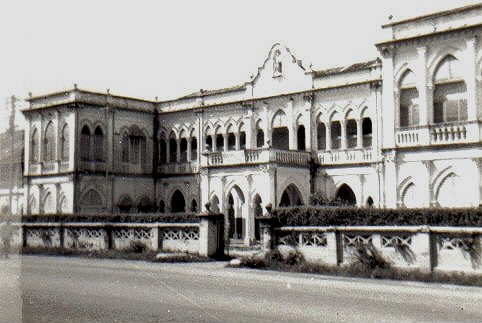
Saint Paul’s Institution, Seremban: A Legacy of Faith, Education, and Service.
Saint Paul’s Institution (SPI) is one of the oldest and most historically significant schools in Seremban and indeed in Malaysia. Established in the final years of the 19th century, it has witnessed the transformation of Negeri Sembilan from a collection of mining towns and Malay chiefdoms into a modern Malaysian state. Originally founded as an all boys school under the auspices of the Catholic mission, SPI now also admits girls for Form Six, reflecting its adaptation to contemporary educational policies while retaining its traditional core values. Commonly known as SPI, its students and alumni are proudly referred to as Paulians a name that evokes a shared identity of discipline, academic pursuit, and service to community.
The school is named after Saint Paul the Apostle, the great missionary and theologian of the early Christian church, whose epistles and journeys laid the foundation for much of Christian thought. The choice of name was deliberate: Saint Paul’s emphasis on learning, perseverance, and universal outreach mirrored the school’s own mission to bring English education to the diverse communities of colonial era Seremban. The school was founded in 1899 by Father Catesson, a French priest of the Paris Foreign Missions Society (Missions Étrangères de Paris), an organization that played a pivotal role in establishing Catholic missions across Southeast Asia. Father Catesson envisioned an institution that would serve not only the local Catholic population but also the broader community, regardless of race, religion, or background. The school’s initial mission was to provide English education to “The boys of Seremban and its outstations” a phrase that reflected the colonial reality of tin-mining outposts, rubber estates, and railway towns spreading across the interior of the Malay Peninsula.
Originally called St. Paul’s School, it holds the prestigious distinction of being the first English school in the state of Negeri Sembilan. This was no small achievement at a time when English-medium education was rare outside the Straits Settlements of Penang, Malacca, and Singapore. The school was officially opened on 18 June 1899 a date still commemorated annually by the Paulian community by two prominent figures of British Malaya: Sir Charles Mitchell, who served as the Governor of the Straits Settlements and British High Commissioner for the Federated Malay States, and Sir E.W. Birch, the Acting British Resident of Negeri Sembilan. Their presence at the opening ceremony underscored the colonial government’s support for English education as a means of producing clerks, interpreters, and minor administrators for the expanding British apparatus. The school began humbly with just 25 students, meeting in a temporary wooden building on the outskirts of Seremban. The first interim headmaster was P.V. Coelho, a lay teacher of Portuguese-Eurasian descent, whose efforts in those early months helped stabilize the fledgling institution amidst financial and logistical challenges.
In the school’s first decade, its growth was steady but modest. The curriculum emphasized English language, arithmetic, geography, and religious instruction subjects considered essential for producing “civilized” colonial subjects. However, it was the arrival of the La Sallian Brothers in the early 1900s that transformed SPI into a major educational force. The Brothers of the Christian Schools, commonly known as the La Sallian Brothers, were a Catholic religious order founded by Saint Jean Baptiste de La Salle in 17th-century France. Renowned for their pedagogical expertise, the Brothers had already established some of the most prestigious schools in British Malaya, including St. John’s Institution in Kuala Lumpur and St. Xavier’s Institution in Penang. When the La Sallians took over the administration of SPI from the Paris Foreign Missions priests, they brought with them a structured, disciplined, and academically rigorous approach to education.
Under the La Sallian Brothers, enrollment surged from a few dozen students to several hundred within a decade. The Brothers introduced a broader curriculum that included science, history, Latin, and sports, as well as a strong emphasis on character formation through religious instruction and extracurricular activities. They also began the tradition of school houses, inter-class competitions, and annual athletic meets practices that remain integral to SPI’s culture today. The school’s reputation for discipline and academic excellence attracted students not only from Seremban and Negeri Sembilan but also from neighboring states such as Malacca, Selangor, and even Sumatra. By the 1920s, SPI was widely recognized as one of the premier English schools outside the Straits Settlements.
Physically, the school underwent a remarkable transformation under La Sallian stewardship. The original wooden buildings, vulnerable to termites and tropical storms, were gradually replaced by more permanent brick and concrete structures. The most iconic of these is the old main building, completed in the 1920s, with its high ceilings, large louvered windows, and distinctive colonial era architecture. The building’s design was intended to maximize airflow in the pre-air conditioning era, while its elevated foundation provided protection against flooding a common hazard in early Seremban. A chapel was also added to the school grounds, serving as a spiritual center for the largely Catholic student body, though non-Catholic students were always welcomed and respected. Playing fields were cleared and leveled, allowing for football, rugby, and cricket. Sports introduced by the British and enthusiastically adopted by generations of Paulians.The Japanese occupation of Malaya (1941–1945) was a dark chapter in SPI’s history. The school was closed for much of the war, and its buildings were repurposed by the Japanese military administration. Many of the La Sallian Brothers were interned or detained, and some former students joined the anti-Japanese resistance or served in the Allied forces. The school’s library and laboratory equipment were looted or destroyed, and the chapel was desecrated. When the war ended and British rule was temporarily restored, the surviving Brothers returned to find their beloved institution in ruins. Yet, with characteristic resilience, they began the slow work of rebuilding. By 1947, SPI had reopened its doors, and enrollment quickly rebounded as post-war Malaya embarked on the road to independence.
The independence of Malaya in 1957, and later the formation of Malaysia in 1963, brought new challenges and opportunities. The national education policy increasingly emphasized the Malay language as the medium of instruction, and many English-medium schools faced declining enrollment or conversion. SPI, however, adapted by offering strong bilingual programs and maintaining its English-stream classes for as long as permitted. Eventually, the school transitioned to the national curriculum while preserving its heritage as an English-focused institution. In the 1970s and 1980s, SPI continued to produce outstanding results in the Sijil Pelajaran Malaysia (SPM) and earlier Cambridge examinations, with many Paulians gaining admission to universities in Malaysia, Singapore, the United Kingdom, Australia, and the United States.Perhaps the most significant change in recent decades has been the school’s shift to coeducation. For over a century, SPI was an all-boys school, a model inherited from the British colonial and Catholic educational traditions. However, to meet the needs of a changing society and to maximize the use of school facilities, the Malaysian Ministry of Education encouraged the gradual integration of girls into formerly single sex schools. Initially, SPI began admitting girls only for Form Six (the pre-university level), a compromise that allowed the school to retain much of its traditional male identity while complying with national policy. Over time, a small number of girls were also admitted into lower forms, though the school remains predominantly male. This evolution has been broadly accepted by the Paulian community, with alumnae now forming an increasingly visible and active part of the school’s alumni network.
The school’s alumni, Paulians have gone on to distinguish themselves in virtually every field of Malaysian life. In politics, SPI has produced members of parliament, state executive councilors, and even a state governor (Yang di-Pertua Negeri). In law, several Paulians have served as judges, including senior positions in the Malaysian judiciary. The school has also produced leading doctors, engineers, architects, educators, and corporate figures. In sports, SPI’s rugby teams have long been formidable competitors at the national school level, producing players who have represented Negeri Sembilan and Malaysia. In the arts, Paulians have made their mark as writers, musicians, and filmmakers, contributing to Malaysia’s cultural renaissance in the late 20th and early 21st centuries.Beyond its academic and extracurricular achievements, SPI is cherished by its community for its traditions.
Today, Saint Paul’s Institution stands as a living monument to over 120 years of educational service. While many older schools in Malaysia have closed or been repurposed, SPI continues to operate, albeit with the challenges of aging infrastructure, urbanization, and shifting demographics. The original La Sallian Brothers have largely been replaced by lay teachers, and the school is now administered under the national education system. Nevertheless, the spirit of Father Catesson and the early La Sallian Brothers endures in every classroom, every playing field, and every assembly hall. For the people of Seremban and Negeri Sembilan, SPI is more than just a school. It is a cornerstone of their collective memory. Generations of families have sent their sons (and now daughters) to SPI, creating a deep emotional attachment that transcends mere bricks and mortar. As Malaysia continues to develop and modernize, Saint Paul’s Institution remains a beacon of its past and a bridge to its future, a place where faith, learning, and service converge, and where the legacy of Saint Paul is renewed with each passing year.